

What is the Heat - Resistance of PET Strapping?
As a supplier of PET strapping, I often encounter inquiries from customers about the heat - resistance of our product. Understanding the heat - resistance properties of PET strapping is crucial for various applications, especially those where the strapping may be exposed to elevated temperatures during storage, transportation, or use.
The Basics of PET Strapping
PET, or polyethylene terephthalate, is a thermoplastic polymer that is widely used in the manufacturing of strapping due to its excellent strength - to - weight ratio, high tensile strength, and good flexibility. PET strapping is commonly employed in industries such as logistics, packaging, and construction for securing goods, bundling items, and providing stability.
Heat - Resistance Characteristics of PET Strapping
The heat - resistance of PET strapping is determined by its chemical structure and the manufacturing process. Generally, PET has a relatively high glass - transition temperature ($T_g$), which is around 70 - 80°C. The glass - transition temperature is the point at which the polymer changes from a hard, glassy state to a more flexible, rubbery state.
When exposed to temperatures below its $T_g$, PET strapping retains its rigid and strong properties. This allows it to withstand the rigors of normal handling and storage conditions without significant deformation. However, as the temperature approaches or exceeds the $T_g$, the molecular chains in the PET polymer begin to move more freely, causing the strapping to become softer and more pliable.
At temperatures above 100°C, PET strapping may start to experience a reduction in its tensile strength. Prolonged exposure to high temperatures can lead to permanent deformation, such as elongation or shrinkage. In extreme cases, if the temperature reaches the melting point of PET (around 250 - 260°C), the strapping will melt, losing its ability to secure the goods.
Applications and Temperature Considerations
Low - Temperature Applications
In most general - purpose packaging and bundling applications, the ambient temperature is well below the $T_g$ of PET strapping. For example, in warehousing and normal transportation, where the temperature typically ranges from - 20°C to 40°C, PET strapping performs excellently. It provides a reliable and cost - effective solution for securing packages, pallets, and bundles of products.
High - Temperature Applications
However, there are certain applications where PET strapping may be exposed to higher temperatures. For instance, in the food industry, products may be shrink - wrapped and then stored or transported in environments with elevated temperatures. In such cases, it is important to assess whether the PET strapping can withstand the expected temperature conditions.
If the heat exposure is short - term and the temperature does not exceed the critical limit, standard PET strapping may still be suitable. But for long - term exposure to high temperatures, specialized heat - resistant PET strapping can be used. These types of strappings are often modified during the manufacturing process to have a higher $T_g$ and better thermal stability.
Comparison with Other Strapping Materials
It is also beneficial to compare the heat - resistance of PET strapping with other commonly used strapping materials.

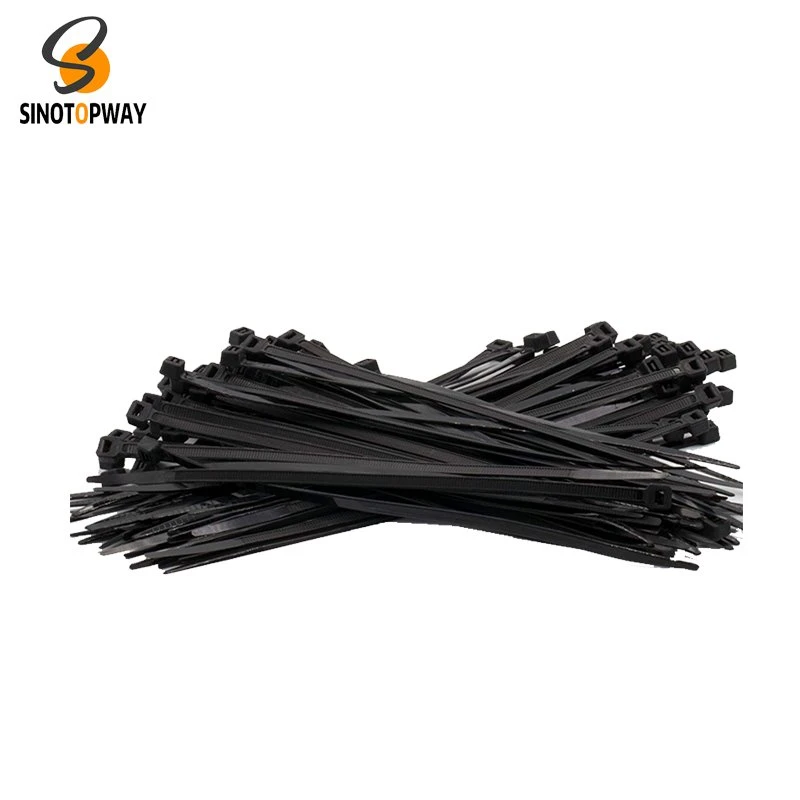
Nylon 66 Heavy Duty Self Locking Cable Ties
Nylon 66 Heavy Duty Self Locking Cable Ties are known for their high strength and flexibility. Nylon 66 has a relatively high melting point of around 260 - 270°C, which is similar to that of PET. However, the heat - resistance behavior of nylon 66 cable ties is different from PET strapping. Nylon 66 absorbs moisture, which can affect its mechanical properties at high temperatures. When exposed to heat, the absorbed moisture can cause the cable ties to expand or lose some of their strength. On the other hand, PET is relatively moisture - resistant, which gives it an advantage in some temperature - and humidity - sensitive applications.
Zinc Coated Steel Strappings
Zinc Coated Steel Strappings are extremely heat - resistant. Steel has a much higher melting point than PET (around 1370 - 1510°C). In applications where extremely high temperatures are involved, such as in the steel industry or certain industrial manufacturing processes, steel strapping is the preferred choice. However, steel strapping is heavier and more expensive than PET strapping, and it may also pose a risk of corrosion in humid environments.
Quality Control and Assurance
As a PET strapping supplier, we implement strict quality control measures to ensure the heat - resistance properties of our products. Our R & D team continuously tests different formulations and manufacturing processes to improve the thermal stability of our PET strapping.
Before shipping our products, we conduct a series of temperature - related tests. These include heat - aging tests, where the strapping is exposed to elevated temperatures for a certain period to simulate long - term heat exposure. We also test the tensile strength of the strapping before and after the heat - aging process to ensure that it meets the required performance standards.
Choosing the Right Pet Strapping for Your Needs
When selecting PET strapping, it is essential to consider the expected temperature conditions during the product's lifecycle. If the application involves normal temperature ranges, standard PET strapping will usually suffice. However, if there is a possibility of high - temperature exposure, it is advisable to consult with our technical team.
We offer a range of PET strapping products with different heat - resistance levels. Our experts can help you determine the most suitable product based on your specific requirements, such as the maximum temperature, duration of heat exposure, and the type of goods being secured.
Conclusion
In conclusion, the heat - resistance of PET strapping is an important factor to consider in various applications. While PET strapping has a good balance of strength and heat - resistance under normal conditions, its performance may be affected at high temperatures. By understanding the heat - resistance characteristics of PET strapping and comparing it with other materials, customers can make informed decisions when choosing the right strapping for their needs.
If you are interested in our PET strapping products and would like to discuss your specific requirements or have any questions about heat - resistance or other properties, please do not hesitate to contact us for a professional consultation and potential purchasing discussion. We are committed to providing you with the best solutions for your packaging and strapping needs.
References
- Billmeyer, F. W. (1984). Textbook of Polymer Science. John Wiley & Sons.
- Mark, J. E. (Ed.). (2007). Physical Properties of Polymers Handbook. Springer.


